Evaluating Laser Cut Welcome Sign Wall Art SVG for Festive Decor
As the holiday season approaches, homeowners and event planners often seek unique ways to refresh their entryways and interior spaces. One increasingly popular method for creating custom decor is the use of digital design files intended for laser cutting. Specifically, the Laser Cut Welcome Sign Wall Art SVG has emerged as a versatile option for crafting personalized greetings. These digital assets allow users to transform raw materials like wood, MDF, or acrylic into intricate, professional-looking signs without needing advanced graphic design skills. Understanding the capabilities, limitations, and practical applications of these files is essential for anyone considering this route for their New Year decorations or year-round home accents.
Understanding the Digital Asset
A Laser Cut Welcome Sign Wall Art SVG is fundamentally a vector-based design file optimized for computer-controlled cutting machines. Unlike standard image files (such as JPG or PNG) which are made of pixels, SVG (Scalable Vector Graphics) files use mathematical paths to define shapes. This distinction is critical because it allows the design to be scaled up or down infinitely without losing resolution or clarity. When paired with formats like DXF and DWG, these files provide the precise coordinates necessary for laser cutters to follow.
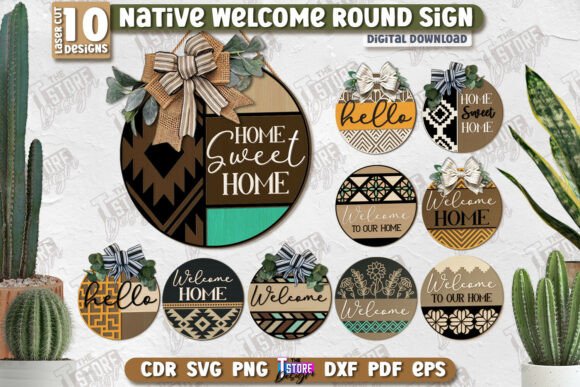
When you acquire a package labeled as a Laser Cut New Year Welcome Sign SVG, you are typically receiving a compressed ZIP file containing multiple file formats. A comprehensive package usually includes AI (Adobe Illustrator), EPS (Encapsulated PostScript), SVG, JPG, PNG, DXF, and DWG files. The inclusion of AI and EPS caters to professional designers using vector editing software, while SVG, DXF, and DWG are directly compatible with most laser cutting software such as Lightburn, Glowforge, and xTool interfaces. The raster images (JPG and PNG) serve primarily for preview purposes or for those who might wish to print the design rather than cut it.
Reasons for Interest and Potential Benefits
The primary driver for interest in these files is the desire for customization combined with efficiency. Traditional sign-making often requires hiring a professional or spending hours hand-carving or painting. In contrast, utilizing a pre-made Laser Cut Welcome Sign Wall Art SVG streamlines the production process. Once the file is loaded into the cutting software, the machine handles the intricate details, ensuring consistency and precision that can be difficult to achieve manually.
There are several tangible benefits to this approach:
- Material Versatility: These designs are generally engineered to work across various substrates. Whether you prefer the warm, rustic look of stained wood, the sleek modernity of acrylic, or the cost-effectiveness of MDF, the vector paths remain valid.
- Scalability: Because the core files are vectors, you can adjust the size of the sign to fit a small apartment door or a large commercial entrance without worrying about pixelation.
- Time Efficiency: For small business owners or hobbyists looking to produce inventory for holiday markets, having a ready-to-cut file eliminates the design phase, allowing immediate focus on production and finishing.
- Complexity Management: Laser cutters excel at creating delicate filigree, interlocking letters, and negative space designs that would be fragile or impossible to create with manual tools.
Practical Considerations and Tradeoffs
While the advantages are significant, potential users must evaluate certain tradeoffs before purchasing and executing a Laser Cut New Year Welcome Sign SVG. The quality of the final product is heavily dependent on the operator's knowledge of their specific machine and material. A file that looks perfect on a screen may result in burn marks, incomplete cuts, or structural weakness if the power, speed, and frequency settings are not calibrated correctly for the chosen material thickness.
Another consideration is the assembly requirement. Many laser-cut welcome signs are designed as multi-layered projects to create depth. This means the user must not only cut the pieces but also sand, stain, paint, and glue them together. This adds a layer of labor and requires additional supplies such as adhesives and finishing agents. For individuals seeking a purely "plug-and-play" solution where the finished object arrives ready to hang, buying a digital file and producing it themselves may not be the most efficient path compared to purchasing a completed sign from a retailer.
Furthermore, compatibility issues can arise. While formats like DXF and SVG are universal, different software interprets nodes and paths differently. Users of Lightburn, Glowforge, or xTool should verify that the provided files open correctly in their specific ecosystem. Occasionally, text elements in SVG files may need to be converted to outlines or paths to ensure they cut as shapes rather than editable text fields.
Ideal Use Cases
This type of digital asset is a strong fit for specific scenarios. It is particularly valuable for:
- Small Business Owners: Crafters selling on platforms like Etsy or at local fairs can use these files to rapidly produce seasonal inventory. The ability to swap materials allows them to offer different price points (e.g., premium hardwood vs. budget-friendly painted MDF).
- Event Planners: For New Year's Eve parties or wedding receptions, these signs can be customized with specific dates or names if the user has basic editing skills, providing high-impact decor at a fraction of the cost of custom commissions.
- DIY Enthusiasts with Equipment: Individuals who have already invested in a laser cutter and enjoy the process of making will find these files to be excellent starting points that reduce design fatigue while maximizing machine utility.
When to Consider Alternatives
Despite the flexibility of a Laser Cut Welcome Sign Wall Art SVG, it may not be the optimal choice for everyone. If you do not own a laser cutter and do not have access to a makerspace or a service bureau that accepts customer-provided files, the purchase is essentially useless unless you intend to hire someone else to run the job, which adds cost and logistical complexity.
Additionally, if your goal is a highly unique, one-of-a-kind artistic statement that deviates significantly from standard typography or symmetrical layouts, a pre-made template might feel restrictive. In such cases, commissioning a custom design or learning vector illustration software to create an original piece from scratch might yield better results. Similarly, for those on an extremely tight budget who only need a simple sign for a single night, a handwritten chalkboard or a printed paper banner might be more cost-effective than purchasing a file and sourcing materials.
Making the Decision
Deciding whether to utilize a Laser Cut Welcome Sign Wall Art SVG ultimately comes down to an assessment of your resources and goals. If you possess the hardware, have a grasp of material properties, and value the ability to produce multiple high-quality units with consistent precision, these files offer an excellent return on investment. They bridge the gap between professional manufacturing and home crafting.
However, success relies on preparation. Before cutting, always perform test runs on scrap material to dial in your machine settings. Ensure you have the necessary post-processing tools for assembly and finishing. By approaching the project with a clear understanding of both the digital requirements and the physical execution, you can effectively leverage these assets to celebrate the New Year or enhance your home decor with style and professionalism.