Magical CNC Corner Brackets for Gothic Shelves
Imagine walking into a room where the shelves don't just hold books; they tell a story. The corners are adorned with intricate moons, hanging keys, and swirling vines that seem to reach out from the wood itself. This is the transformative power of Decorative Bookshelf Corner Brackets CNC. Whether you are a seasoned woodworker with a fully equipped shop or a hobbyist looking to add a touch of wizardry to your home library, these digital designs offer a gateway to creating custom, ornate decor without needing to carve every detail by hand.
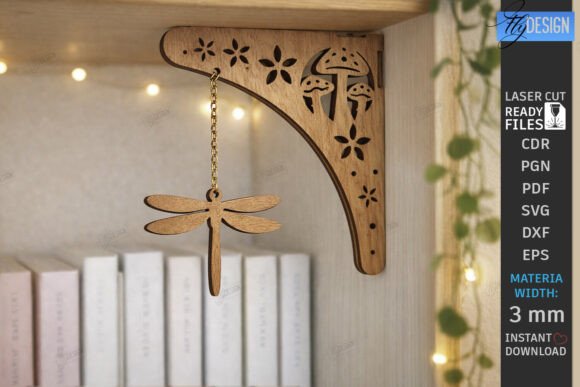
At their core, these files are vector-based instructions designed for computer-controlled machinery. Specifically, they are optimized for laser cutters and CNC routers working with materials like 3mm plywood. The design philosophy here blends functionality with high-fantasy aesthetics. Unlike standard L-brackets found in hardware stores, which are purely utilitarian and often hidden, these brackets are meant to be seen. They serve as structural supports while acting as the primary decorative element of a shelving unit. The files typically include specific color coding—red lines for cutting paths and black lines for engraving details—ensuring that the machine knows exactly how to render the intricate patterns that define the "witchy" or "gothic" look.
Why Different Creators Care About Ornate Shelf Designs
The appeal of these laser-cut ready files varies significantly depending on who is holding the mouse. For a homeowner or interior design enthusiast, the priority is often aesthetic impact and ease of installation. They may not own a laser cutter themselves but purchase these files to send to a local maker space or an online fabrication service. For them, the value lies in the uniqueness of the final product. A standard bookshelf feels mass-produced; a shelf supported by moon-and-key motifs feels curated and magical. It allows individuals to personalize their living spaces, turning a generic apartment corner into a dedicated reading nook that reflects their love for fantasy literature or gothic architecture.
Conversely, for small business owners and entrepreneurs, these files represent a low-overhead product opportunity. In the world of Etsy and handmade marketplaces, niche decor sells well. A creator can purchase a single digital pack containing SVG, EPS, DXF, PDF, and PNG formats and produce hundreds of physical units. Their evaluation criteria shift toward production speed, material yield, and finish quality. They need to know if the 3mm plywood specification holds up under the weight of hardcover books or if the intricate cutouts are prone to breaking during shipping. For this group, the "commercial value" and "reliability" of the design file are paramount. They are looking for a design that minimizes waste and maximizes visual appeal to justify a higher price point than plain wooden brackets.
Technical Considerations for Beginners and Pros
If you are a beginner stepping into the world of digital fabrication, the terminology can feel overwhelming. You might wonder about the difference between the provided file types. An SVG (Scalable Vector Graphics) or DXF (Drawing Exchange Format) is usually what your laser software needs to interpret the cut lines accurately. These formats ensure that when you scale the bracket up or down, the lines remain crisp and the dimensions stay true. The inclusion of multiple formats like EPS and PDF ensures compatibility across different design suites, from Adobe Illustrator to free alternatives like Inkscape.
For the novice, the most critical lesson is understanding the "Red line – CUT, Black line – ENGRAVE" protocol. This is a universal language in laser cutting. If your software interprets a black line as a cut instead of an engrave, you might accidentally slice your intricate moon design in half. Therefore, checking machine compatibility before starting is essential. Beginners should also pay attention to material choice. While 3mm plywood is standard for these delicate, ornate designs, using a material that is too thick can cause the fine details to burn or fail to cut through, while material that is too thin may lack the structural integrity to support a shelf.
Experienced users and professionals, however, look at these files with a different eye. They see a base template that can be modified. A professional might take the original "Wizard and Witchy" design and adjust the vector nodes to fit a non-standard shelf depth or to accommodate a specific type of wall mounting hardware. They appreciate the clean vector paths that prevent the laser head from making unnecessary movements, which saves time and reduces burn marks on the wood. For them, the "flexibility" of the file is key. Can they easily separate the engrave layer from the cut layer? Is the geometry closed and valid for nesting software to optimize sheet usage?
Practical Applications Across Various Projects
The versatility of these decorative brackets extends beyond simple bookshelves. Consider the following scenarios where different audiences might apply these designs:
- The Educator: A woodworking teacher might use these files to teach students about the relationship between digital design and physical output. The project covers vector editing, material properties, and assembly, providing a complete learning loop in a single class session.
- The Event Planner: For a themed wedding or a Halloween party, these brackets can be used to create temporary, atmospheric displays. Because they are made of lightweight plywood, they are easy to transport and set up, adding instant gothic ambiance to a venue without permanent construction.
- The Content Creator: Bloggers and YouTubers focusing on "Book Nook" aesthetics or fantasy room makeovers can use these as a focal point in their videos. The visual complexity of the laser-cut details makes for excellent close-up shots, driving engagement and showcasing the potential of DIY home decor.
- The Gift Giver: Instead of buying a generic gift, a hobbyist can fabricate a custom shelf bracket set for a friend who loves reading. Adding a personal engraved message alongside the moon and key motifs transforms a functional item into a cherished keepsake.
Evaluating Quality and Long-Term Usefulness
When deciding if a specific pack of Decorative Bookshelf Corner Brackets CNC fits your needs, consider the end goal. If you are building a heavy-duty archive for rare books, you must evaluate whether the ornate cuts compromise the structural strength. In such cases, you might choose to use a thicker material and adjust the file settings, or use the decorative bracket purely as a facade over a hidden metal support. However, for displaying paperbacks, collectibles, or light decor items, the 3mm design is often perfectly sufficient and offers a delicate, lace-like appearance that thicker materials cannot achieve.
Furthermore, think about the finish. Raw plywood has a rustic charm, but these designs often shine when stained or painted. A deep walnut stain can enhance the gothic vibe, making the engraved details pop with shadow, while a white wash can give them an ethereal, fae-court aesthetic. The long-term usefulness of the digital file lies in this adaptability; the same file can produce a dark, moody accessory for a study or a bright, whimsical accent for a child's room simply by changing the finish.
Ultimately, these files bridge the gap between imagination and reality. They allow creators to bypass the years of training required to hand-carve such intricate details, democratizing access to high-end custom decor. Whether you are cutting your first piece of wood or running a full-scale fabrication business, the ability to instantly produce complex, story-driven hardware opens up new possibilities for how we build and decorate our spaces. By understanding your specific needs—be it speed, aesthetics, or educational value—you can leverage these tools to create something truly magical.